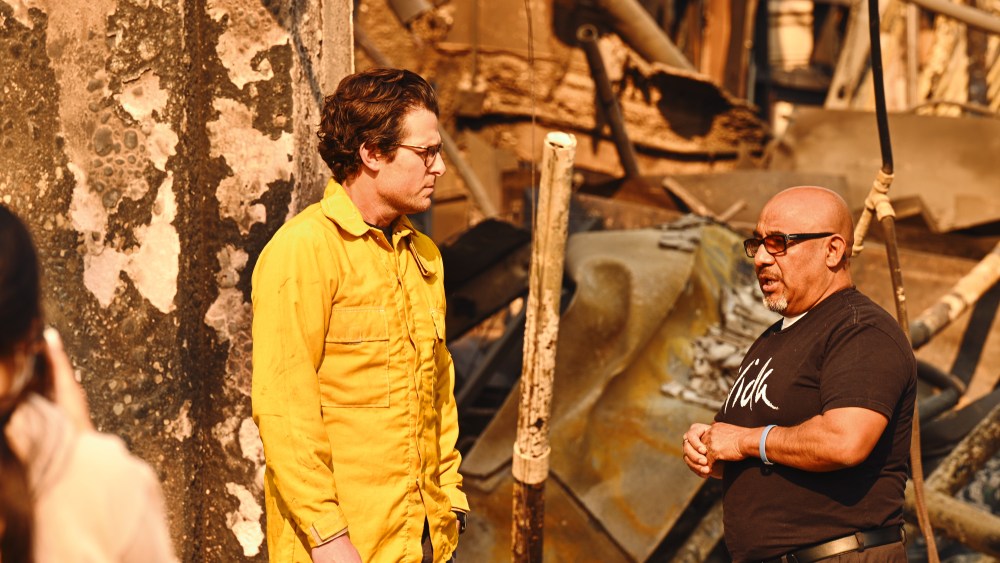
Jacob Soboroff will never forget the feeling he had as he rushed out of the NBC News’ Los Angeles bureau on the afternoon of Jan. 7, 2025, as word began to spread of a devastating fire in the area where he grew up in Pacific Palisades.
The veteran correspondent and author volunteered to go the chaotic scene because of his personal connection and familiarity with the area. Within 48 hours, his childhood home and most of what he remembered from his youth in the 1980s and ’90s had been reduced to ashes and rubble.
Soboroff turned his in-the-moment reporting into the basis for a book that chronicles the extraordinary events of Jan. 7 and Jan. 8, which left more than 6,800 homes and buildings in the Palisades and Malibu area. Another 9,400 homes and structures were destroyed 35 miles away to the east in Altadena. “Firestorm: The Great Los Angeles Fires and America’s New Age of Disaster,” was published Jan. 6 by Mariner Books, an imprint of HarperCollins.
Here, Soboroff discusses his reporting on the still-disputed events that unfolded during the peak of the inferno, and what it portends for the future of weather-driven disasters.
Your book title is “Firestorm: The Great Los Angeles Fires and America’s New Age of Disaster.” I want to start by talking about the second half of that, of that title. In the reporting of this, what did you learn about America’s new age of disaster?
I ended up covering the carbonization, the destruction, the incineration of my childhood home and my childhood hometown, and watching it happen in real time with my own eyes. And I couldn’t comprehend at the time exactly what I was witnessing. What I have come to learn in writing this book and spending the better part of 2025 diving deep into the experience that I had, and reflecting on it and reporting it out, is that in some measure it was the fire of the future. And so when I say America’s new age of disaster, to me, it also is synonymous with the fact that I experienced what one senior career emergency management official who has spanned Democratic and Republican administrations said to me was something not only that was a look into my past, at my childhood, but also into my own children’s future.
So what the new age of disaster is, and what the fire of the future is, is a conflagration, excuse the term, of several things. There is not one proximate cause to natural disasters like the one we experienced in L.A., the costliest wildfire event in American history. It was obviously the global climate emergency, but it’s also the degradation of our infrastructure. It’s also changes in the way we live. I went back and listened to a lot of audio and watched video of my reporting, and I heard electric car batteries exploding all around us. And I think maybe most importantly, it is the misinformation and disinformation, the charged political moment that we’re living in that makes the recovery from events like this all the more difficult, and all the more painful, instead of the opposite, which is what I think we all expect.
In doing all of this investigative reporting with incredible sourcing that you have, but did you find things that helped you understand where that infrastructure is just breaking down?
In the book in particular you see the relationship completely falling apart between Gavin Newsom, the governor of California and Donald Trump, the President-elect at the time. [President] Joe Biden, a lot of people might forget, was actually here in Southern California when the fires broke out. He was going down to the Coachella Valley and to the Chuckwalla National Monument to dedicate the final national monument of his presidency. Gavin Newsom, as you will see, was literally on his way driving there, getting ready to meet Joe Biden. And their relationship, interestingly, was critical to the major disaster declaration being declared almost immediately, because the two of them were in person together, and the President United States was here, but Donald Trump almost inexplicably injected himself from the moment that the fires started and started sowing the seeds of misinformation and disinformation about who was to blame, about whether one person could be to blame for something like this. And of course, he blamed “Newscum.” And [Los Angeles] Mayor Karen Bass, but also pointed a finger at the water supply, saying that there was some magical, mystical source of water from the Pacific Northwest that could, quote, unquote, flow down with a tap that would open, and it would have stopped the fires or prevented them from happening in the first place. I’m not absolving local political leaders at all. Gavin Newsom promised me when I interviewed him for ‘Meet the Press’ a Marshall Plan 2.0 for Los Angeles, I haven’t seen that materialized. Karen Bass, of course, was in Ghana on that presidential delegation [when the fires began], and there are lots of questions about what could have been done differently operationally, whether it’s deploying firefighters to different places in the Palisades, or taking down those big steel lattice towers in Altadena that were inactive but were the source of the Eaton fire. All of that there is ripe for decades, frankly, of investigative journalism that’s happening from from our colleagues in the local media in Los Angeles.
But what this book will show you is that in real time, minute to minute, what it was like to be there and what it was like to feel Elon Musk down at Zuma Beach, talking to firefighters, pressing them on a live stream, and Gavin Newsom watching and having to respond in real time, what it was like for residents to experience this confusion about information, where it was coming from, and what the source of it was and how to even figure out when and how to evacuate. I think all of it combined sowed the seeds for the travesty that we all experienced together, collectively, and the trauma that we’re all trying to still recover from, which is part of the reason I wanted to do this. I’ve never had to process a story I have personally covered in the way that I had to cover this one. And so for me, it’s as cathartic as I hope it might be for people reading it in Los Angeles and around the world to want to learn about this event and what it really meant to the people, in my opinion, the greatest city in the world.
In the immediate aftermath of the fires there was discussion about maybe there should have been more accessibility and exit routes in the central core of the Palisades that was so devastated. Was it hard to report those kinds of things about your hometown?
I can’t wait for people to read the scenes in the book about L.A. Fire Department air support having to figure out that they had to ground themselves. This is not something is not something that anybody that is in that line of work takes lightly. And so the decision to ground those choppers really does show the severity of the conditions at the time, and then as it relates to the building materials and the fact that we all, in some some way, put ourselves in harm’s way. That’s not new. In the 1960s when, after the Bel-Air fire, the L.A. Fire Department produced a documentary called “Design for Disaster,” and it literally talked about how the ways in which we live in Los Angeles are primed to make us all victims of massive wildfire events like happened in the ‘60s and happened again in early January of 2025 and so now I think it’s more acute and more sort of obvious than ever to everybody. The question is, do we when we come back, if we come back, and there are big questions about that, how do you build back? Is it? Is it a decision that everyone will make to want to live in such vulnerable circumstances as part of the paradox of living in a place that is unbelievable and as deadly as Mike Davis has told us all about Los Angeles.
City of Quartz. Of course, Hollywood is the big hometown business. Did you get a sense of how the entertainment industry was affected by the fires? One thing we saw right afterwards was a lot of calls for more tax incentives and government support to keep the industry here. For a moment it seemed like there was going to be some good that comes out of this for the industry.
What it meant for the entertainment industry and what it meant for our neighbors who work in in Hollywood and who have been really suffering. Perhaps for a moment it did open the eyes to the policymakers that we need to incentivize people to continue to come to work in Southern California and in Los Angeles, because of how clear it was after the fires, how bad the industry was hurting. And I think that that same story can sort of be extrapolated as well to the defense of immigrants that we’re seeing in the city while they’re rebuilding, or the realization that L.A. is one of the most unaffordable cities, not only in the United States, but on planet Earth. And all of these things are issues that needed to be addressed before the fire, but I think in the wake of the fire it is crystal clear for all of us how acute those issues are.
Have you and your family found a way to memorialize or process all that you lost?
There’s a physical memorial outside the Palisades Recreation Center, the building was around World War II. There is a giant bronze plaque about the rebuilding of the park at the Palisades Park in 1986 when I was two going on, three years old, that my dad and my mom and my four grandparents all participated in the fundraising for. That plaque still stands. And when I go back there, I see the names, not just of my mom and dad and my grandpa Irv, and grandma Evelyn and my mom’s parents, but I see the names of so many neighbors, some of whom lost their homes in the fire, some of whom I hadn’t thought about in a long time, some of whom are no longer with us. It’s where I go every time I go back to the Palisades now, because it reminds me of what that place was, not just in the days before the fire, because it had changed, but what that place means to me. And I hope that everybody can find something like that for them as we try to move forward from this. And I think that the book hopefully can be that for a lot of people.
